0 £0.00
products in your basketto quote Checkout
Ooops no items were found.
Try something else.
Ok
Loading…

ESG Compliance Guide

ESG Compliance Office Checklist UK: A Practical Guide for Businesses (2026)

A practical workplace checklist to help UK businesses turn environmental, social and governance goals into everyday actions across procurement, waste, employee wellbeing and accountability.

ESG priorities are often clear at leadership level but harder to translate into day-to-day office decisions. This guide focuses on practical areas businesses can review, measure and improve.

A practical ESG framework, not a legal compliance certificate ESG requirements can vary according to organisation size, sector, reporting obligations, customers and supply-chain requirements. This checklist is designed to help identify practical workplace improvements rather than replace professional legal, regulatory or reporting advice.

The Bigger Picture

Why ESG matters in the modern office

ESG is no longer only a boardroom or annual-reporting topic. Customers, employees, investors and procurement teams increasingly want to understand how organisations approach environmental responsibility, people and corporate governance.

Day-to-day office operations may appear small compared with wider corporate strategy, but purchasing, recycling, employee wellbeing, supplier selection and record keeping all contribute to the bigger picture.

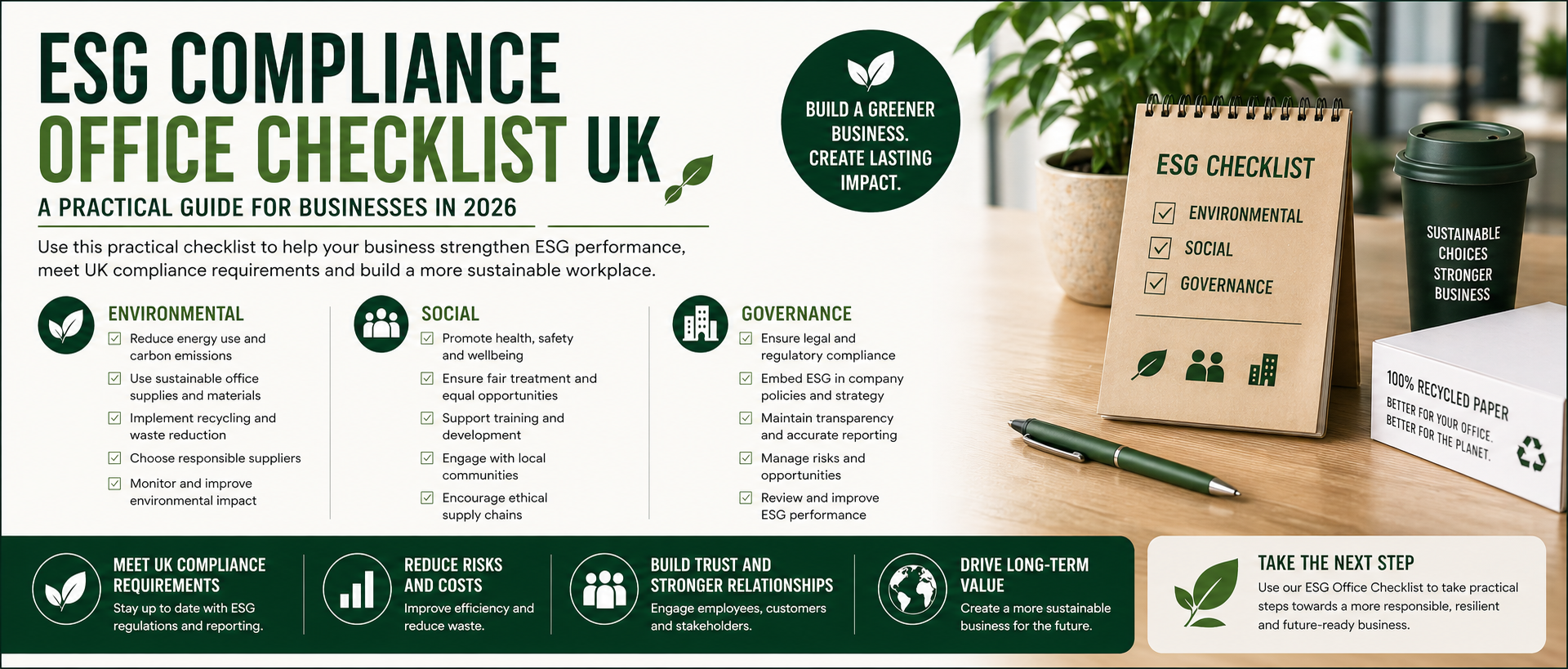
E — Environmental Waste, energy, materials, purchasing, recycling and environmental impact.
S — Social Employee wellbeing, inclusion, workplace conditions and supply-chain considerations.
G — Governance Policies, responsibilities, records, targets, supplier standards and accountability.

Environmental

Environmental checklist for UK offices

Environmental improvements often begin with products and systems used every day. Paper, stationery, waste management, cleaning products and office equipment are all useful places to start.

  • Review the use of recycled and responsibly sourced paper across everyday printing.
  • Choose longer-lasting, refillable or recycled-content pens and writing instruments where practical.
  • Reduce unnecessary single-use products in kitchens, washrooms and meeting spaces.
  • Improve workplace recycling with clearly identified collection points and office recycling bins .
  • Review lighting, heating, cooling and office-equipment energy use.
  • Track relevant purchasing, waste and energy data where reliable information is available.

Paper & Printing

Review everyday paper and printing

Paper is a useful ESG procurement category because it is frequently purchased, easy to measure and available in a wide range of recycled and certified options.

Consider whether routine office documents can use recycled paper, while responsibly sourced certified products can cover applications where another specification or finish is required.

For a detailed comparison, read FSC vs Recycled Paper: Which Is Better for Your Office?

Waste Management

Build a clearer workplace recycling system

Recycling is easier to manage when waste streams are clear, bins are positioned where waste is generated and employees understand what belongs in each collection point.

Everyday Recycling Provide clearly identified bins for common workplace recyclable materials.
Specialist Waste Consider dedicated recycling schemes for items such as toner cartridges and pens.
Reporting Structured business waste services can provide better visibility of collection and recycling activity.

Read our Business Recycling Services UK guide for more detail on bins, workplace waste separation, specialist recycling and First Mile services.

Social

Social checklist for responsible workplaces

The social element of ESG looks at how organisations affect people, including employees and those within their wider supply chain.

  • Provide appropriate ergonomic furniture and workplace equipment
  • Review employee wellbeing and workplace comfort
  • Support inclusive workplace policies and practices
  • Consider ethical labour and sourcing standards when reviewing suppliers
  • Provide suitable channels for employees to raise concerns
  • Encourage staff participation in sustainability initiatives

Employee wellbeing can also influence purchasing decisions. For example, comfortable and durable office chairs and well-planned furniture can support a better working environment.

Governance

Governance checklist for better accountability

Environmental and social improvements become more meaningful when they are supported by clear responsibilities, policies, records and regular review.

  • Create or review your ESG or sustainability policy
  • Assign responsibility for key ESG actions
  • Document significant workplace sustainability initiatives
  • Review supplier and procurement standards
  • Maintain appropriate anti-corruption and whistleblowing policies
  • Set measurable targets where suitable data exists
  • Review progress at defined intervals

Procurement

How sustainable procurement supports ESG goals

Procurement is one of the most practical areas where ESG policy can influence everyday workplace decisions.

Instead of considering price alone, purchasing teams can assess product longevity, recycled content, responsible sourcing, packaging, refill options, waste implications and supplier practices where relevant.

Buy Less Often Durable and reusable products may reduce unnecessary replacement and waste.
Choose Better Materials Consider recycled, recyclable or responsibly sourced products where appropriate.
Review Suppliers Look beyond the individual product and consider the information suppliers provide about their approach.

For organisations with formal sustainability objectives, our Sustainable Office Supplies for B Corps guide explores procurement and recycling in more detail.

Common Gaps

Where office ESG programmes often fall short

Organisations can make good progress in one area while overlooking another. The most useful ESG reviews look across purchasing, waste, people and governance together.

No baseline Improvement is difficult to demonstrate when nothing was measured at the start.
Unclear ownership Actions can stall when nobody is responsible for implementation or review.
Supplier blind spots Product decisions can conflict with wider objectives when supplier standards are never reviewed.
No follow-up A one-off sustainability exercise is less useful than regular measurement and improvement.

ESG Checklist

Your ESG office checklist at a glance

Area Action Review
Paper & Stationery Review recycled, refillable and responsibly sourced alternatives. ☐
Waste & Recycling Check bin locations, waste streams and recycling arrangements. ☐
Energy Review lighting, heating, cooling and equipment usage. ☐
Employee Wellbeing Review ergonomics, comfort and workplace support. ☐
Suppliers Review relevant environmental, social and sourcing standards. ☐
Policies Document responsibilities, policies and internal procedures. ☐
Measurement Set suitable indicators and review progress regularly. ☐

Getting Started

Where should a business start?

Trying to address every ESG issue at once can make the process unnecessarily difficult. Start with areas that are easy to understand and where change can be measured.

1. Review Understand current purchasing, waste, workplace and policy arrangements.
2. Prioritise Identify realistic actions with meaningful potential benefits.
3. Measure Record suitable baseline information and monitor improvement over time.

Keep Reading

Related ESG & sustainable workplace guides

Sustainable Office Supplies for B Corps Practical procurement and recycling ideas for organisations focused on improving sustainability performance. Business Recycling Services UK Build a more structured recycling system using workplace bins, waste separation and business collections. How The Green Office Supports Sustainable Workplaces See how product choices, procurement, waste reduction and environmental initiatives can work together. How to Create an Eco-Friendly Office on a Budget Practical ways to make workplace sustainability improvements without unnecessary spending. 5 Easy Eco-Friendly Office Supply Swaps Start with simple everyday product changes that are easy for workplaces to implement. Sustainability Impact Report Q2 2026 See our latest reported tree-planting progress and sustainability impact.

Final Thoughts

Turn ESG goals into everyday workplace decisions

ESG does not have to begin with a large transformation programme. For many businesses, a useful starting point is simply understanding what the office buys, what it throws away, how employees are supported and who is responsible for improvement.

By combining better procurement, clearer recycling, responsible workplace practices and stronger accountability, organisations can make ESG principles part of normal business operations rather than a separate annual exercise.

Start with practical workplace improvements

Explore more sustainable office supplies, recycling solutions and practical workplace products.

Shop Eco Office Supplies Recycling Solutions Ask Our Team

SEARCH ×

Search