
Indoor Air Quality Guide
How to Choose the Right Indoor Air Quality Monitor for Your Workplace
Indoor air quality is easy to overlook because many of the most important warning signs are invisible. A room can feel normal while CO2, humidity, VOCs or fine particles are rising.
For offices, schools, meeting rooms, care homes, gyms and shared workplaces, an indoor air quality monitor gives you a simple way to see what is happening in the room and decide when action may be needed.
In this guide, we explain what air quality monitors measure, why CO2 monitoring is useful, and how to choose between a simple CO2 monitor, a data-logging monitor and a smart multi-sensor device.
Quick answer: which monitor should you choose?
For everyday classroom, office and meeting room ventilation checks, choose a straightforward CO2 monitor such as the Kidde KCO2M10UK CO2 Air Quality Monitor.
For facilities teams or users who want trend history, data logging and customisable alarms, consider the SA1200P CO2 Indoor Air Quality Monitor.
For broader smart monitoring, including radon, PM2.5, VOCs and app-based insights, look at the Airthings 2960 View Plus Smart Radon & Air Quality Monitor.
Why indoor air quality monitoring matters
Indoor spaces can quickly become stuffy when people are working, learning or meeting in the same room for long periods. One of the easiest ways to understand ventilation is to monitor carbon dioxide, or CO2. People breathe out CO2, so rising levels can suggest that a room needs more fresh air.
The Health and Safety Executive explains that CO2 monitors can be a useful way to estimate airflow rates in occupied rooms. It also notes that CO2 levels consistently higher than 1500ppm in an occupied room indicate poor ventilation and that action should be taken to improve it.
The Department for Education also provides guidance for education and childcare settings on monitoring ventilation and air quality. This is one reason many schools and trusts now see classroom CO2 monitors as a practical part of building management.
What does an indoor air quality monitor measure?
Different monitors measure different indicators. The right option depends on your building, the room type and the level of detail you need.
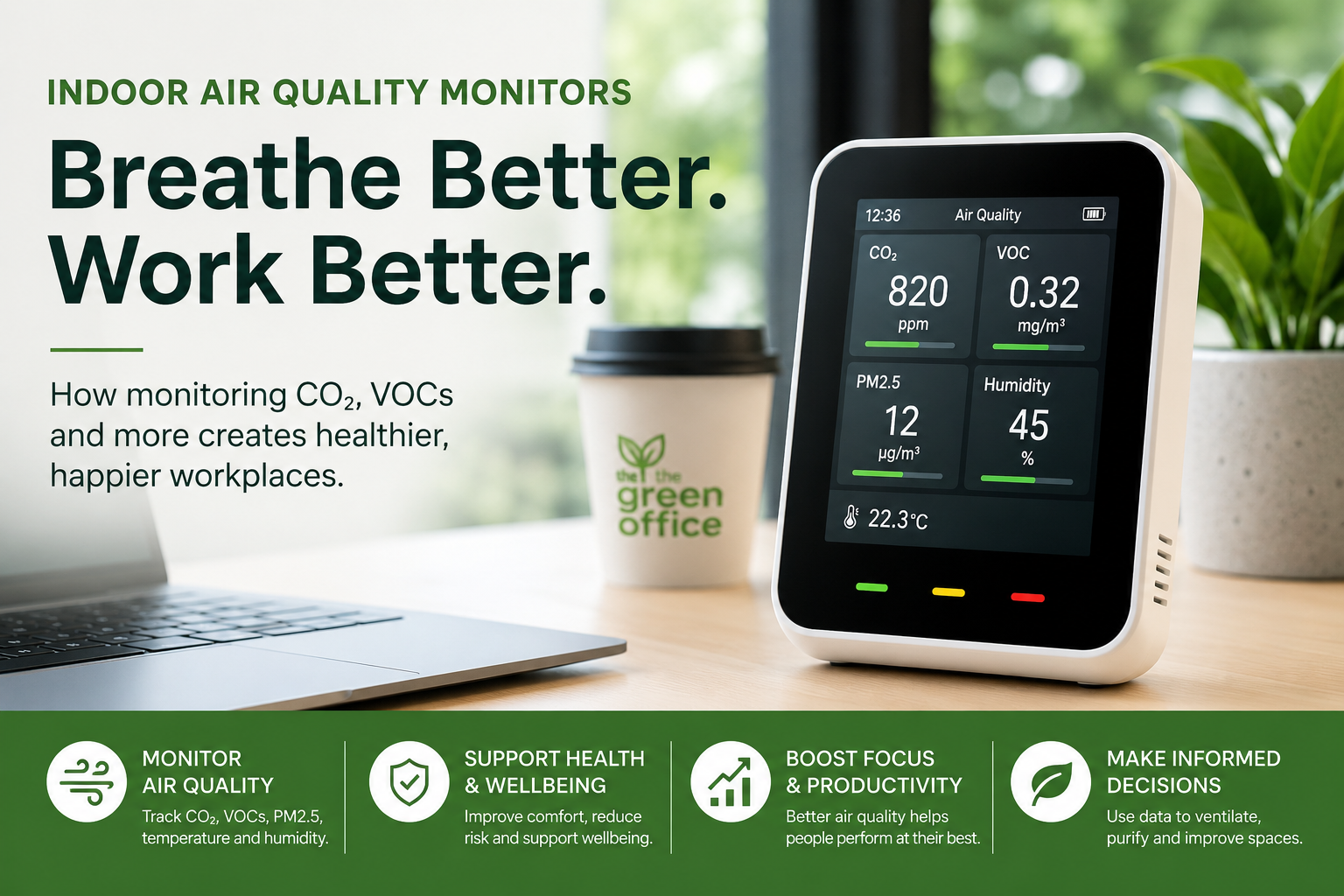
- CO2: helps indicate whether an occupied room is well ventilated.
- Temperature: helps monitor comfort in offices, classrooms and shared spaces.
- Humidity: helps identify conditions that may affect comfort, dryness, damp or condensation risk.
- VOCs: airborne chemicals from sources such as cleaning products, furniture, paints and materials.
- PM2.5: fine airborne particles from dust, smoke, pollution, printers and other sources.
- Radon: a naturally occurring gas that some smart air quality monitors can help track over time.
CO2 monitors: the practical starting point
For many workplaces and schools, a CO2 monitor is the best place to start. It gives staff a simple, visible prompt when ventilation may need attention.
The Kidde KCO2M10UK Mains Powered CO2 Air Quality Monitor is ideal for simple day-to-day use. It monitors CO2, temperature and humidity, and is well suited to classrooms, offices, meeting rooms and other shared indoor spaces where users need a clear reading without overcomplication.
Data-logging monitors: useful for trends and evidence
Some organisations need more than a live reading. Facilities managers, school business managers and health and safety teams may want to understand how readings change through the day, across the week or during specific room use.
The SA1200P CO2 Indoor Air Quality Monitor with NDIR Sensor is a strong choice where trend charts, data logging and customisable alarms are useful. It measures CO2, temperature and humidity, making it suitable for offices, classrooms, libraries, gyms, hospitality spaces, workshops and warehouses.
Smart multi-sensor monitors: for a broader air quality picture
If you want to monitor more than ventilation, a smart multi-sensor monitor can provide a wider view of the indoor environment. This is useful for organisations looking at air quality more strategically or managing a wider range of potential pollutants.
The Airthings 2960 View Plus Smart Radon & Air Quality Monitor tracks multiple indicators including CO2, PM2.5, VOCs, humidity, temperature, air pressure and radon. It is a premium option for users who want app access, dashboard insights and a broader understanding of indoor air quality.
Compare indoor air quality monitors
| Product | Best for | Measures | Why choose it? |
|---|---|---|---|
| Kidde KCO2M10UK | Offices, classrooms and meeting rooms | CO2, temperature and humidity | Simple, practical CO2 monitoring for everyday ventilation checks. |
| SA1200P CO2 Monitor | Facilities teams, schools and workplaces needing history | CO2, temperature and humidity | Includes data logging, trend charts and customisable alarms. |
| Airthings View Plus | Premium smart air quality monitoring | Radon, PM2.5, CO2, VOCs, humidity, temperature and pressure | A smart multi-sensor option with app and dashboard visibility. |
Where should you use an air quality monitor?
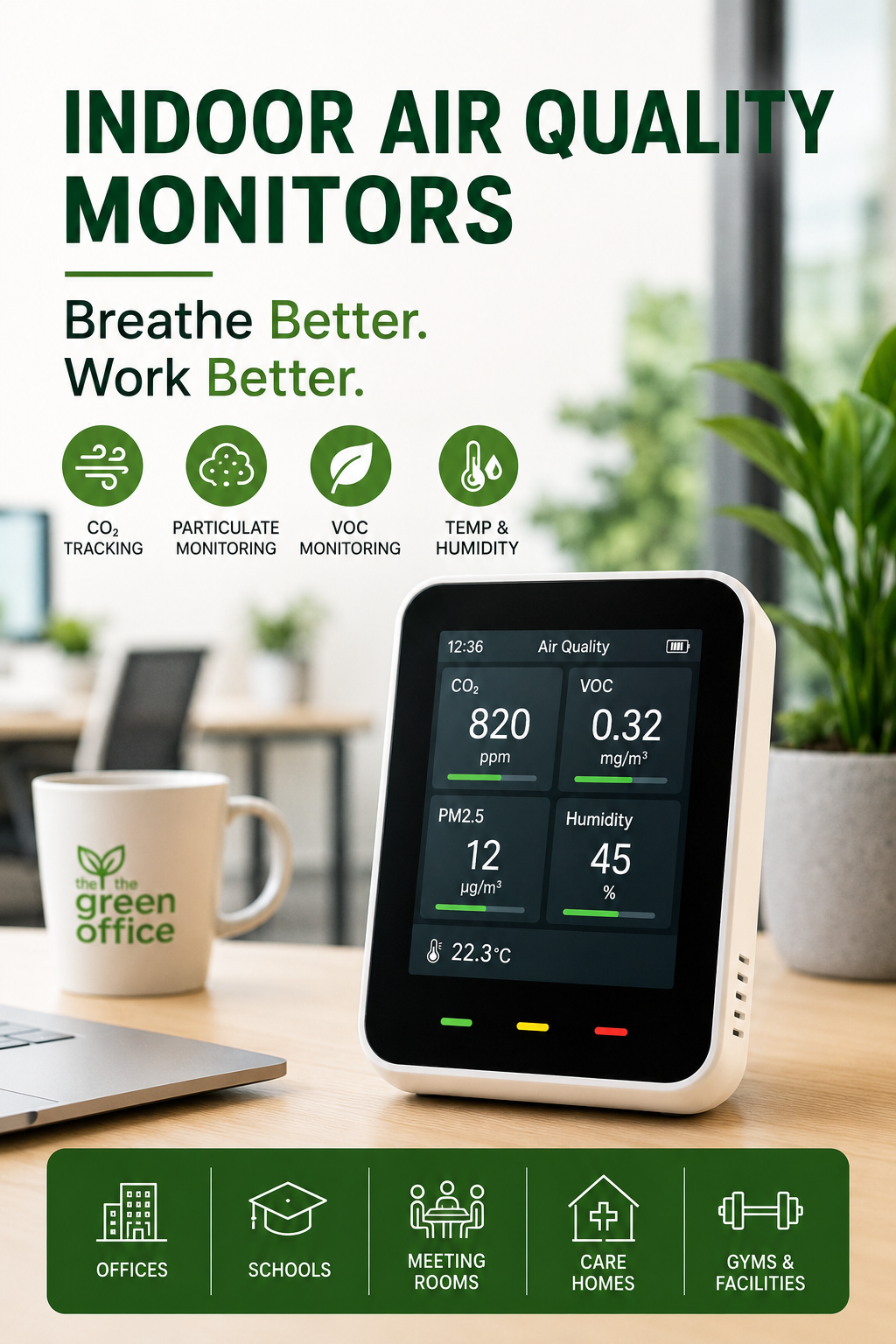
Air quality monitors are most useful in occupied spaces where ventilation levels can change throughout the day. Common locations include:
- office meeting rooms and boardrooms
- classrooms, halls and shared learning spaces
- care home lounges and communal areas
- gyms, studios and changing rooms
- reception areas and waiting rooms
- warehouses, workshops and shared commercial spaces
What should you do when readings are high?
A monitor is most useful when readings lead to practical action. Depending on the space, you may need to open windows, increase mechanical ventilation, reduce occupancy, review room use, service ventilation systems or investigate sources of pollutants.
If particulate readings are high, or if opening windows is difficult because of weather, security, traffic noise or outdoor pollution, an office air purifier may help support cleaner indoor conditions alongside good ventilation practice.
Ready to start monitoring your indoor air quality?
View our full range of indoor air quality monitors to compare CO2, data-logging and smart air quality monitoring options for your workplace.
Frequently asked questions
What is the best indoor air quality monitor for an office?
For most offices, a CO2 monitor is a practical starting point because it helps indicate whether meeting rooms and shared spaces are well ventilated. For broader monitoring, choose a smart multi-sensor monitor that also tracks VOCs, PM2.5 and humidity.
Do schools need CO2 monitors?
CO2 monitors are useful in schools because they help staff identify rooms where ventilation may need to be improved. They can be used in classrooms, halls, staff rooms and other occupied spaces.
What does an NDIR CO2 sensor mean?
NDIR stands for non-dispersive infrared. It is a sensor technology commonly used to measure carbon dioxide directly, making it a strong option for ventilation monitoring.
Should I buy an air purifier as well as a monitor?
A monitor helps you understand the problem. An air purifier may be useful where particulate levels are high or where ventilation is difficult. Monitoring and purification work best as part of a wider indoor air quality plan.
Featured Blog Posts
Latest Blog Posts
.jpg)

.jpg "Green Office Free Delivery")


