

Office Paper Comparison Guide
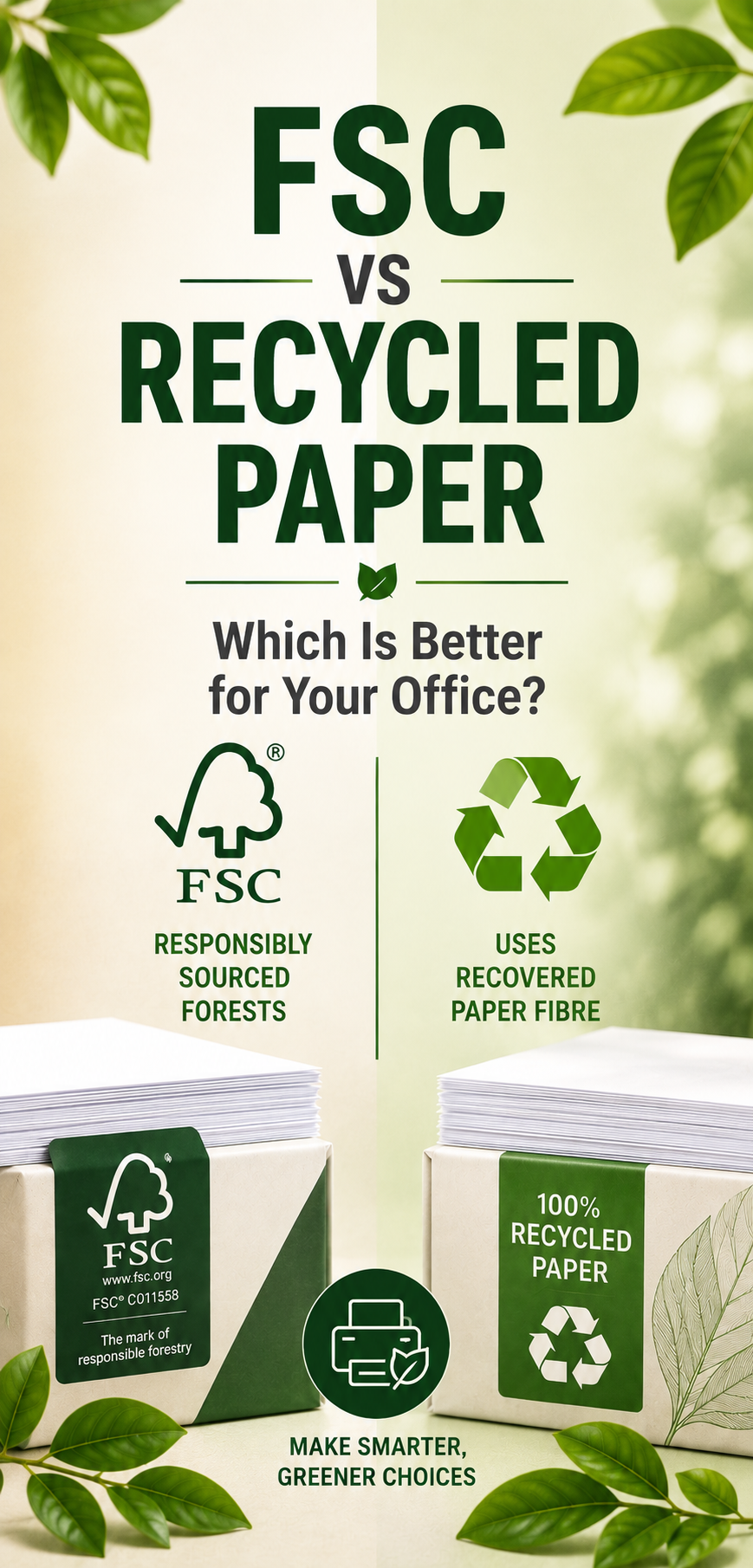
FSC vs recycled paper: which is better for your office?
It is not really an either-or question. Recycled content tells you about the material used to make the paper, while FSC certification tells you about sourcing and chain of custody.
A paper can be recycled, FSC-certified, both, or neither. The most appropriate choice depends on what you are printing, how much paper you need, the recycled content, sourcing information, paper weight and required print performance.
This guide explains the difference and shows how to make a more useful purchasing decision than simply asking which label is “greener”.
Recycled-content claims tell you that recovered paper fibre has been used instead of relying entirely on newly produced virgin fibre.
FSC certification provides information about forest-based material and the chain-of-custody controls behind the sourcing claim.
The Most Important Point
FSC-certified and recycled are not opposites
FSC has three main product labels: FSC 100%, FSC Mix and FSC Recycled. FSC Recycled products contain 100% verified recycled forest-based material.
So a paper can simultaneously be recycled and FSC-certified. The labels are answering different questions about the product.
Understanding the Difference
What does each claim actually tell you?
What is recycled paper?
Recycled paper uses recovered paper fibre as a raw material. The recycled percentage can vary, and recovered material can include pre-consumer and post-consumer sources.
A product described as 100% recycled therefore tells you something specific about its fibre content, but not necessarily everything about sourcing, manufacturing, transport or overall lifecycle performance.
What is FSC-certified paper?
FSC certification provides a recognised framework for forest management and for controlling FSC material claims through the supply chain.
Depending on the label, an FSC product can contain material from FSC-certified forests, recycled material and/or FSC controlled wood.
FSC Is Not One Single Material Claim
The three FSC labels
Side-by-Side Comparison
FSC certification vs recycled content
| Question | Recycled Content | FSC Certification |
|---|---|---|
| What does it primarily tell me? | How much recovered fibre is used | Information about sourcing and chain of custody |
| Can it contain virgin fibre? | Depends on the recycled percentage | Yes, depending on the FSC claim |
| Can it be 100% recycled? | Yes | Yes — FSC Recycled |
| Does it guarantee better print quality? | No | No |
| Should I check the individual product? | Yes | Yes |
Consider Recycled Paper When
Recovered fibre suits the application
Recycled paper can be particularly appropriate for everyday correspondence, reports, forms, internal documents and other regular office printing where the selected grade performs reliably.
Check the recycled percentage, paper weight, printer compatibility and any relevant certification rather than treating “recycled” as a complete specification.
Consider Certified Fibre When
Virgin fibre is required or appropriate
Where virgin fibre forms part of the paper specification, recognised certification such as FSC or PEFC can provide useful sourcing information and chain-of-custody assurance.
This may be relevant because of a particular paper specification, procurement policy or requirement that is not met by the recycled alternatives being considered.
A Common Misconception
FSC paper is not automatically “premium” and recycled paper is not automatically lower quality
FSC certification tells you about sourcing, not whether the paper is 80gsm or 120gsm, bright white or natural, smooth or rough, or designed for everyday copying or professional digital printing.
The same applies to recycled content. Modern recycled papers are available across different grades and performance levels. Compare the actual paper specification rather than assuming the fibre source determines print quality.
A Better Office Paper Policy
Instead of “FSC or recycled”, use this hierarchy
Recycled Paper
Want to understand recycled fibre in more detail?
Our dedicated recycled paper guide covers recycled-content percentages, post-consumer fibre, print performance, whiteness and practical buying considerations.
Why Choose Recycled Paper?Responsible Sourcing
Want to understand FSC and PEFC properly?
Our certification guide explains FSC, PEFC, chain of custody and the different on-product claims in more detail.
FSC & PEFC ExplainedBefore You Buy
Seven useful questions for any office paper
Reduce First. Then Choose Better.
The best paper decision sometimes starts by using less paper
Neither FSC certification nor recycled content makes unnecessary printing necessary.
Digital workflows, duplex printing, reducing unnecessary copies and choosing an appropriate paper weight should form part of the same purchasing strategy as recycled content and responsible sourcing.
FSC vs Recycled Paper FAQs
Common questions about recycled and certified paper
Is FSC paper better than recycled paper?
They cannot be directly ranked because they describe different attributes. FSC certification relates primarily to sourcing and chain of custody, while recycled content describes the use of recovered fibre.
Can recycled paper be FSC-certified?
Yes. FSC has an FSC Recycled label for products where the forest-based material has been verified as 100% recycled.
Is FSC-certified paper made from virgin fibre?
It depends on the FSC label. FSC 100% uses material from FSC-certified forests, FSC Mix can contain certified, recycled and controlled material, and FSC Recycled uses recycled material.
Is recycled paper lower quality?
Not inherently. Recycled papers are available in different weights, whiteness levels and performance grades. Judge the individual paper specification and intended application.
Should an office use 100% recycled paper for everything?
Not automatically. Where a suitable recycled grade performs the job reliably it can be a sensible choice, but different print applications may have different technical requirements.
What is the best paper policy for a business?
Reduce unnecessary printing, choose an appropriate paper weight, consider recycled content where suitable, look for credible sourcing information and verify the specification of the individual paper being purchased.
Related Paper Guides
Build a better office paper specification
Choose Paper with Better Information
Do not choose between FSC and recycled until you know what your office actually needs
Reduce unnecessary printing first, then compare recycled content, responsible sourcing, paper weight and print performance before choosing the most appropriate sheet.
Featured Blog Posts
Latest Blog Posts
.jpg)

.jpg "Green Office Free Delivery")


